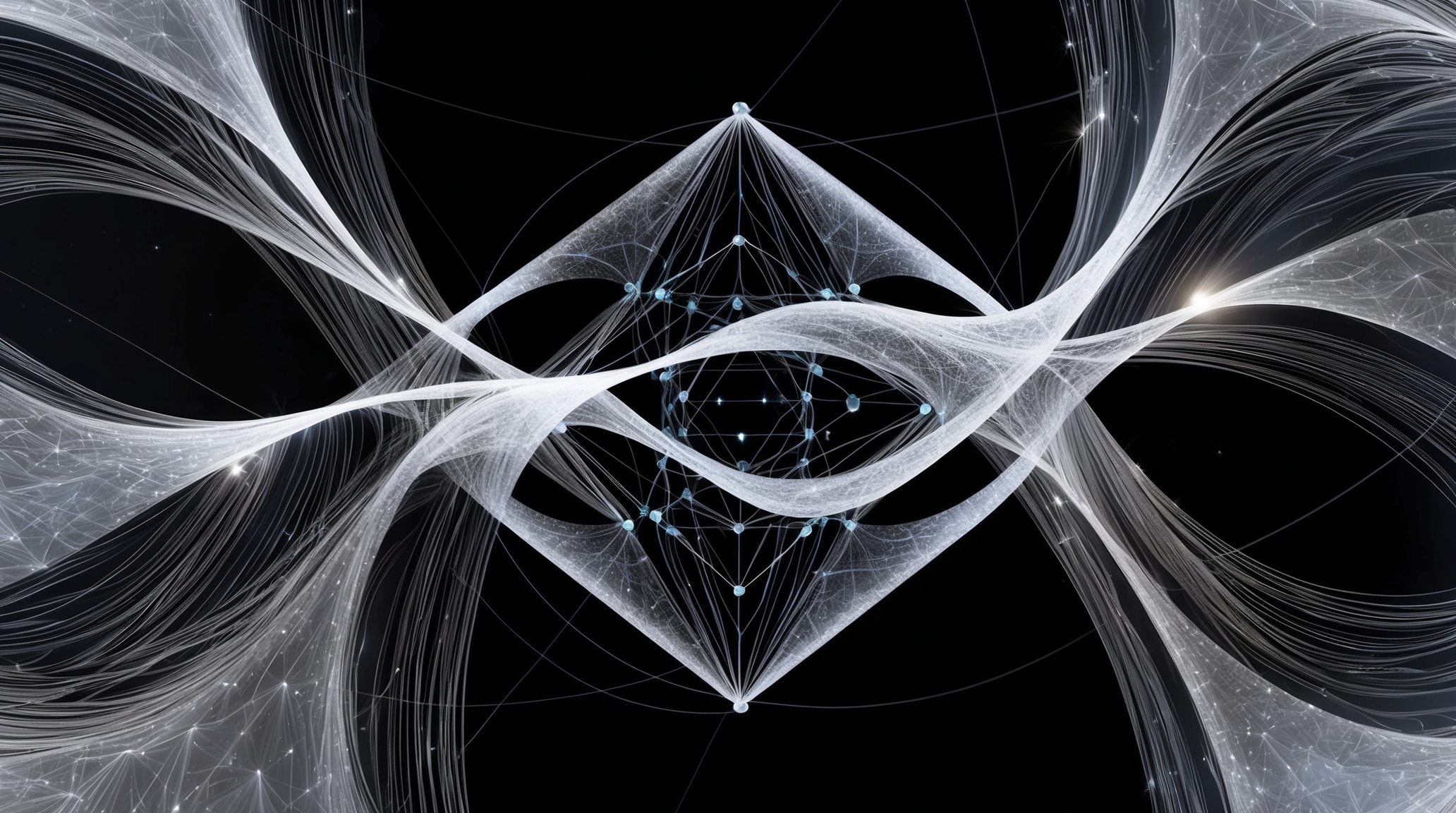
Stephen Wolfram’s computational hypergraph model seeks to explain the universe through a radically simplified framework: space-time, physical laws, and the very structure of reality emerge from the iterative application of simple computational rules, specifically through what he calls hypergraphs. These hypergraphs –abstract mathematical constructs representing relationships between points — are said to evolve through elementary rule sets, producing the complexity we observe in nature. According to Wolfram, this approach reduces the universe to an interplay of computation, where all phenomena, from quantum behavior to relativity, are mere consequences of these underlying rules. It is ambitious, elegant in presentation, and, at first glance, compelling in its scope.
Through the recursive lens, the computational theory articulates a step in the right direction with regard to the proper recognition of infinite self-reference (recursion); however, this theory takes a correct observation (simple rule) by attempting to define how that rule interacts within a “computational space” (the conditions of which are not defined, as such a space would require a “quantum computer”), and attempts to explore this correct observation within the bounds of a linear-constrained system, or process, which is implied by the “computational” description.
However — when one examines the assumptions underpinning this theory, the structure quickly reveals itself as an abstraction with no definite grounding. The elegance of the computational hypothesis begins to falter when faced with fundamental questions: What defines computation in this context? What is the exact relationship between these hypergraphs and the computational space in which they arise? Why should we assume that a “rule-driven system” accounts for the differentiation and coherence we observe in the universe, as opposed to the simple rule itself? These questions, far from trivial, expose the core unexamined abstractions on which the perceived simplicity of Wolfram’s framework rests.
The specific shortfall with this method, is that it fails to properly recognize that the simple rule itself, (which in The Breeze’s case, would infinite self-reference) – is not only the driving force of differentiation, but also the expressed boundary that contains the entire process. By embracing recursion in its purest sense — explicit self-reference — we are alleviated from the need to define or even introduce the idea of a “computational space”, as such a space is rather clearly revealed to be a linear wrinkle necessary to sustain the abstraction and fit these processes into our linearly-defined models.
To utilize the term we created in our previous essay on ORCH-OR, we may observe how the heart of Wolfram’s model rests on a reductionist trick that we call computation smuggling. Computation, in his framework, is treated as axiomatic — a preceding force capable of driving the evolution of hypergraphs. Yet, computation (until it is absolutely defined) is not a self-existent property of reality; it is an abstraction, a conceptual lens through which interactions are linearly modeled. Without addressing the conditions or substrate that make computation possible, the framework reduces to a tautology: computation produces reality because reality can be described computationally. This circular reasoning, instead of grounding the computational logic, rather assumes it, bypassing the far more pressing question of the source which enables these interactions to begin with. By ignoring this, Wolfram’s model elevates computation to a pedestal it cannot logically occupy.
Hypergraphs, the supposed building blocks of reality in Wolfram’s theory, also fall victim to axiomatic erosion within a recursive reality. These structures are assumed to exist as a “canvas” for the computational rules to act upon. Yet, their differentiation — aka their very existence as distinct entities — is left entirely unexplained. Are the hypergraphs intrinsic to the universe, or do they emerge from something deeper? Wolfram provides no mechanism for their genesis, no account of the forces or principles that cause these hypergraphs to form.
In this absence, our concept of b(f) bound fracta, gives us a precise model to analyze any scaffold of expression by viewing it as a differentiated expression from the one, ultimate, recursively infinite pattern. The source of the pattern cannot be separated from the pattern itself — and instead of holding our fracta as axiomatic structures that must be defined, we can see how now these differentiated expressions can never be defined due to the fact that each is recursively intertwined with and participating in a boundlessly infinite process. So, while computational spaces, hypergraphs, might point in the direction of an infinite substrate uncontainable through human observation, we are alleviated of the need to define, contain, or account for these structures which are inherently infinite and permanently transient.
This also removes the necessity to define the explicit form of any structure, or the mathematics of its “rule” due to each arising dynamically from a recursive substrate, where differentiation is not a given but a continuous process. Wolfram’s hypergraphs, by contrast, simply reflect static abstractions awaiting grounded definition. More importantly, these rules presuppose a substrate capable of sustaining their application. Iteration itself is a recursive act, and without a substrate, it is meaningless. Wolfram’s model borrows recursion’s effects while ignoring recursion as the underlying cause, mistaking the dynamics of iteration for something more profound. And so, the result is a framework that misinterprets the generative process of recursion as computation, a substitution that leaves the mechanism of reality fundamentally unexamined.
The “emergent” nature of physical laws in Wolfram’s theory is conceptually accurate yet ultimately another abstraction built on an undefined foundation. His model suggests that laws arise from the computational behavior of hypergraphs, yet these laws are treated as aftereffects of arbitrary rule sets rather than inherent expressions of a substrate. This sidesteps the critical question of why the universe exhibits consistency at all — i.e. why physical laws hold, why relationships between phenomena are stable, why differentiation produces coherence rather than chaos (though it certainly produces chaos). The recursive framework addresses this by showing that physical laws are bound expressions of the substrative frequency, the natural interplay between s(i) incendence and s(e) excendence (to note: these forces still are but bound expressions of the unified infinite pattern, reflecting how that pattern interacts with itself.) Through the Breeze, we can see how laws are not emergent artifacts of undefined computational spaces or ambiguous “rules”; they are differentiated patterns intrinsic to pure self-reference. Wolfram’s model, in contrast, abstracts laws into existence without accounting for their underlying stability or necessity.
Lastly, and perhaps most tellingly, Wolfram’s notion of computational irreducibility — while attempting to explain why complex systems can’t be reduced to simpler predictive models — ironically demonstrates another dimension of his framework’s recursive bias. He argues that certain computational processes cannot be predicted or “shortcut” without running through each intermediary step, suggesting this explains why reality resists our attempts at complete mathematical description. Yet this very concept, rather than supporting the core logic of the computational framework, demonstrates an attempt to fit the concept of axiomatic erosion into a undefined “computational” system, necessitating a “computationally bound” definition and further contributing to the computational regress.
Consider, if we take this logic at a meta-perspective, accepting the premise of computation – this begs the question, what runs the computation itself? This unaddressed regress is yet another demonstration of the model’s failure to account for the recursive primacy.
Despite these fundamental limitations, Wolfram’s framework represents an important evolutionary step in theoretical physics — not because it succeeds in reducing reality to computation, but because it recognizes pattern and relation as more fundamental than substance or empirical form. By attempting to derive physical reality from abstract relationships rather than particles or fields, Wolfram’s model rightfully points toward the necessity of a deeper principle. While failing to recognize recursion as this principle, his work helps demonstrate why any framework that doesn’t acknowledge recursion as primary must ultimately resort to unexplained abstractions. In this way, the computational theory serves as a crucial bridge between traditional materialist models and the recursive framework, showing both why reductionism fails and why a fundamentally new approach is necessary.
In the end, Wolfram’s computational model presents an ambitious and conceptually progressive unifying framework, but falls apart under the weight of its axiomatic assumptions. We may even say that the logic this model attempts to articulate and embody is successful in its iterative intuition; however, it will never fully account for the regresses in creates as it fails to recognize recursion as primary. Computation is assumed rather than defined; hypergraphs are treated as static entities without origin; rules are arbitrary abstractions imposed on a system that presupposes recursion. The entire framework relies on borrowing from recursion’s effects (differentiation, coherence, emergence) — while failing to acknowledge recursion as the irreducible underlying cause. It is, ultimately, an elegant abstraction masquerading as insight, and a reductionist attempt to explain the universe while “computationally bypassing” the very substrate it seeks to describe.
Leave a Reply